
A reflection for Tuesday of the 17th Week in Ordinary Time.
Jesus’ explanation of the parable of the weeds can sound very clear-cut.
There are good seeds and bad seeds. There are the righteous and the evildoers. At the end, there will be a separation.
That kind of clarity can be reassuring. We like to know where we stand. We like to believe that goodness and evil are easy to identify, and perhaps even easier to locate in other people.
But then Jeremiah speaks.
The people in the first reading are not innocent. They know they have failed. They acknowledge their sins and still cry out to God. They ask for healing. They ask for mercy. They ask God not to abandon them.
And God remains the one to whom they turn.
That complicates things.
Because the people of God are not simply the “good seed.” They are faithful and unfaithful, repentant and stubborn, hopeful and broken. They belong to God, and they also need forgiveness.
So do we.
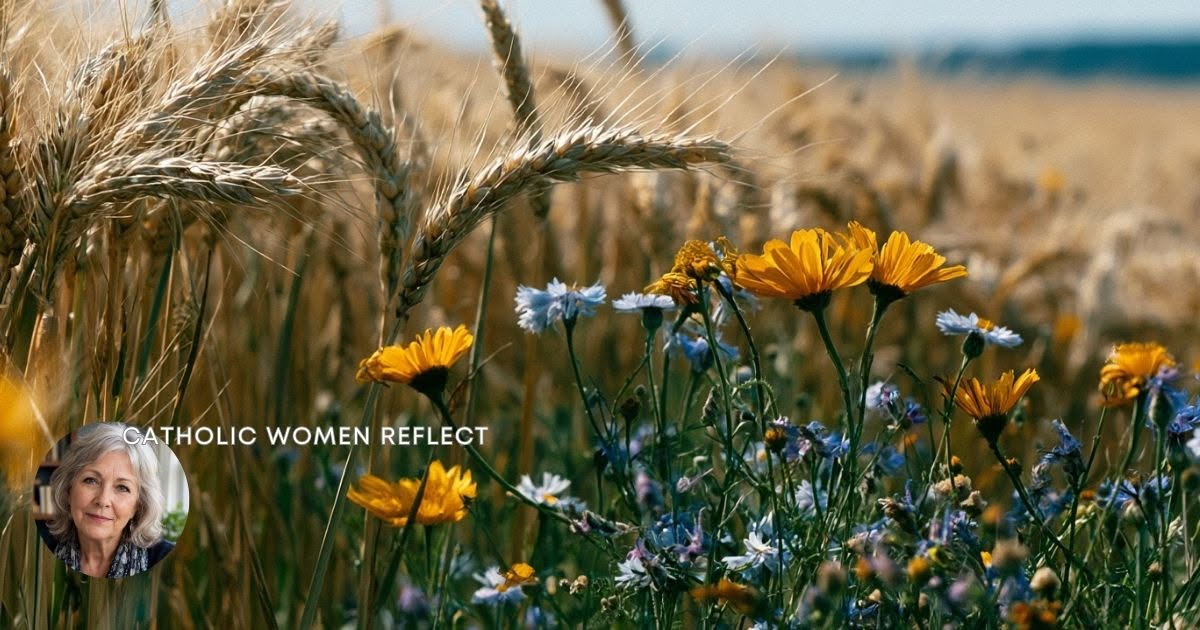
In an earlier reflection, I wrote that the field belongs to God. The landowner in Jesus’ parable refuses to let the servants pull up the weeds, because in doing so they may damage the wheat. That image still stays with me. But today’s readings invite us to go one step further.
Perhaps the wheat and the weeds are not only growing beside one another.
Perhaps they are growing within us.
There are parts of ourselves that are generous, compassionate, patient, and faithful. And there are other parts that are selfish, fearful, judgmental, resentful, or proud. We can be kind one day and harsh the next. We can speak beautifully about mercy and still struggle to offer it to someone who has hurt us. We can trust God deeply in one part of our lives and cling tightly to control in another.
Human beings are rarely as simple as the labels we place on them.
Yet we are very good at labels.
Faithful. Unfaithful.
Good Catholic. Bad Catholic.
Liberal. Conservative.
Devout. Fallen away.
Worthy. Unworthy.
We can begin to believe that these words tell us everything we need to know about another person.
They do not.
A person who appears distant from the Church may still carry a deep hunger for God. Someone who seems certain in faith may be hiding profound doubt. A person whose life does not fit neatly within Church expectations may show extraordinary compassion, courage, and generosity. Someone who appears outwardly righteous may be carrying bitterness or judgment that no one else can see.
And none of us knows the whole story.
Jeremiah’s people know they have sinned, but they do not conclude that they are beyond mercy. They continue to pray.
The psalm makes the same plea: do not remember our past sins. Help us. Forgive us. Save us.
There is such humility in that prayer.
It does not say, “We are the good ones.”
It says, in effect, “We need mercy.”
Perhaps that is one of the healthiest things a religious community can say.
The Church is at its best when it remembers that it is not a gathering of people who have successfully separated themselves from the weeds. It is a community of people who need grace.
That should make us gentler with one another.
It should make us cautious about deciding who belongs and who does not. It should make us less interested in sorting people into categories and more interested in accompanying them. And it should remind us that holiness is not the same as perfection.
There is also something freeing in admitting the weeds within ourselves.
We do not have to pretend.
We can acknowledge our jealousy, our anger, our failures, our prejudices, our fear, our impatience. We can bring all of it to God.
Jeremiah does not hide the people’s sin before asking for mercy.
Neither do we need to.
Repentance is not self-hatred. It is honesty in the presence of a God who still loves us.
And perhaps that honesty helps us become more compassionate toward others. When we know how much mercy we need, it becomes harder to deny mercy to someone else.
Jesus does speak of judgment in today’s Gospel. Evil matters. Harm matters. Justice matters. Christianity is not an invitation to shrug our shoulders at cruelty or injustice.
But final judgment belongs to God.
Our task, in the meantime, is not to decide who is wheat and who is weed.
Our task is to keep turning toward God. To keep growing. To keep repenting. To keep practicing mercy. To keep trusting that grace is at work in lives we do not fully understand.
There is wheat in us.
There are weeds in us too.
And still God does not abandon the field.
Leave a Reply