
A reflection on Jeremiah 18:1-6 for Thursday of the 17th Week in Ordinary Time.
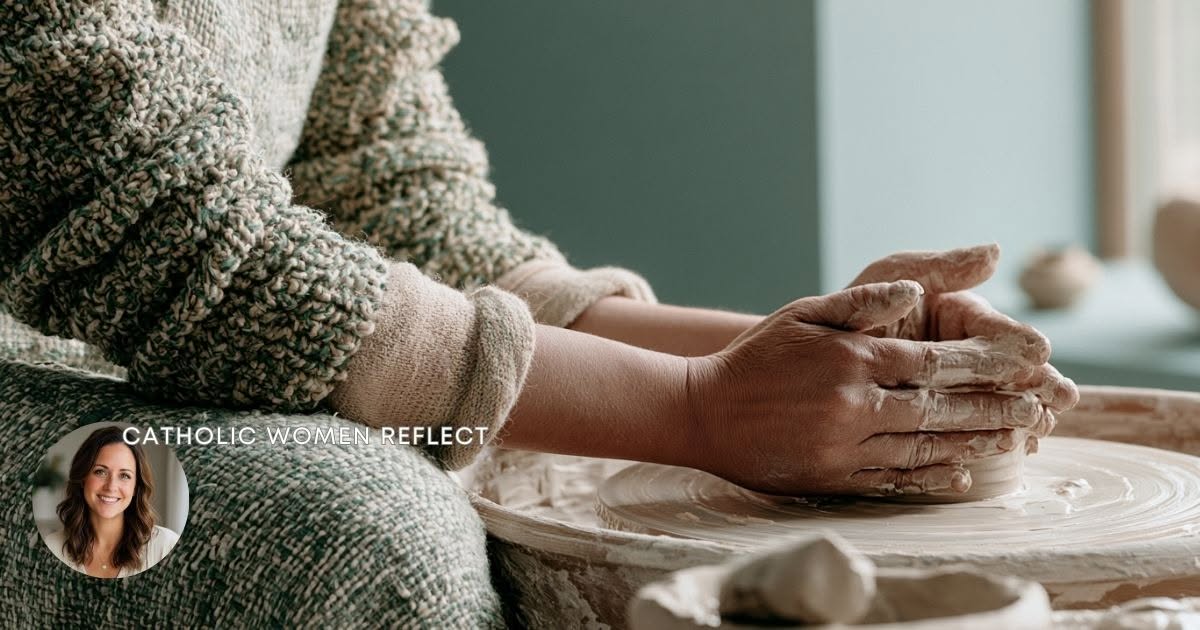
There is something deeply comforting in the image God gives Jeremiah: a potter sitting at his wheel, shaping clay with patient hands.
The vessel does not turn out as expected. It becomes misshapen. Something goes wrong in the forming. But the potter does not throw the clay away. He begins again, reshaping it into something new.
I think many of us need that image.
There are seasons when our lives do not look the way we thought they would. Plans change. Relationships strain. We make choices we regret. We discover weaknesses we had hoped were long behind us. Sometimes we look at ourselves and see only what has gone wrong.
But God sees clay that is still in his hands.
That does not mean our choices do not matter. Jeremiah’s message is not that God overlooks sin or that nothing has consequences. It is a call to repentance and surrender. Yet even within that call is mercy. The spoiled vessel is not discarded. It can be reworked.
This is one of the quiet graces of the spiritual life: God is not finished with us simply because we have failed.
We often prefer the idea of being formed once, cleanly and beautifully, without interruption. We want steady progress and visible improvement. We want to feel as though each year has made us wiser, gentler, and more faithful.
But real conversion is rarely so tidy.
Sometimes God must soften what has become hardened. Sometimes he must press into places we would rather protect. Sometimes the shape we were trying to maintain is not the one he intends for us.
The clay cannot always understand the pressure of the potter’s hands.
When life feels uncertain, it is tempting to assume that everything is falling apart. Yet what feels like undoing may also be reshaping. A closed door, a disappointment, or an honest recognition of our own limits can become the place where God begins forming something more truthful in us.
The challenge is to remain soft enough to be changed.
Clay that hardens cannot be easily shaped. Our hearts can harden too—through pride, resentment, fear, or the need to control the outcome. We may say that we trust God while resisting any path that differs from the one we imagined.
The potter’s house asks a difficult question: Do I trust God enough to let him change the shape of my life?
That surrender is not passive. It may require confession, apology, patience, or the courage to begin again. Grace does not erase our participation. It makes renewal possible.
There is great hope in knowing that God works with what is actually before him, not with the ideal version of us we wish we could offer. He receives the whole truth: the beauty, the damage, the softness, and the resistance.
And still, he works.
We may feel unfinished, uneven, or far from what we hoped to become. But we are not abandoned.
We are still in the Potter’s hands.
Leave a Reply