
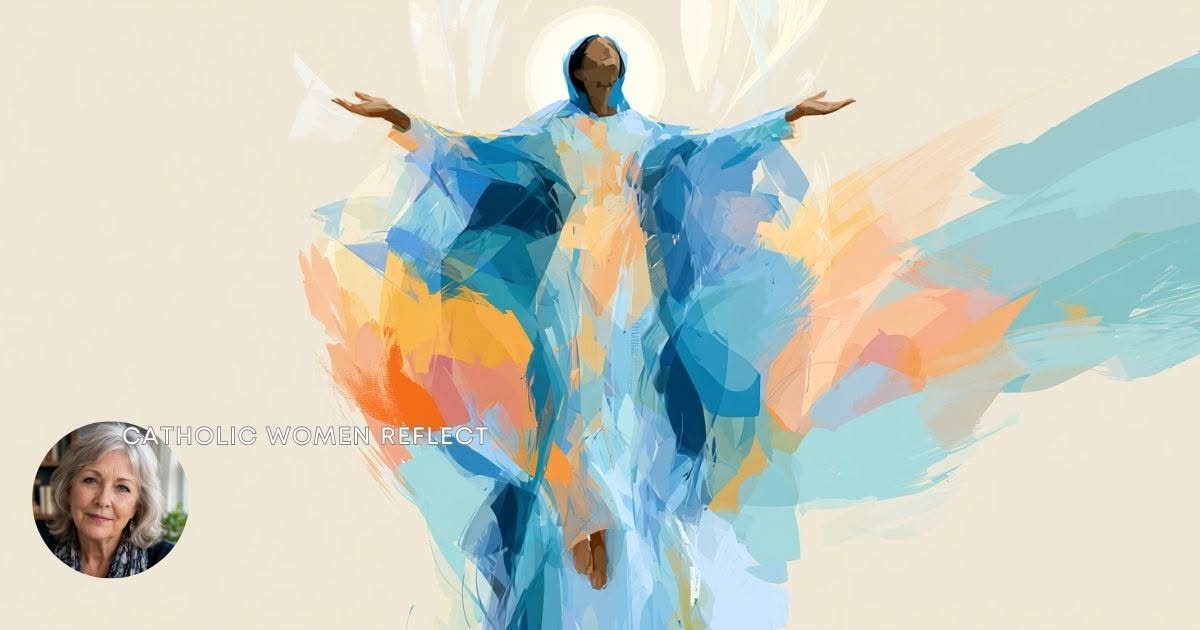
The Assumption of Mary can sometimes sound almost too heavenly for ordinary life.
Mary is taken into glory, body and soul. It is beautiful language, but perhaps a little difficult to connect with the bodies we actually inhabit: bodies that age, ache, scar, change, tire, bleed, give birth, fail us, surprise us, and occasionally make getting out of a chair more of a spiritual exercise than we had planned.
And yet that is exactly why this feast matters.
The Assumption is not about Mary escaping her body.
It is about God refusing to discard it.
Christianity has sometimes had an uneasy relationship with the body. We speak easily about the soul, the spirit, heaven, and eternal life. Bodies can seem like the troublesome part of the arrangement, the bit we are expected to discipline, distrust, or rise above.
But the Christian story is stubbornly physical.
God becomes flesh.
Jesus eats, sleeps, touches, weeps, bleeds, and dies.
He rises bodily.
And in Mary, the Church sees a promise that the human body is not something God eventually throws away once the “important” spiritual work is finished.
The body matters.
That is especially worth saying about women’s bodies.
Women have heard an astonishing amount about what our bodies should look like, how much space they should occupy, what they should wear, how they should age, when they should bear children, whether they should bear children, and what their bodies supposedly say about their virtue.
The Church has participated in some of that scrutiny.
For centuries, women’s bodies have often been discussed more than women themselves have been invited to speak. Rules and teachings affecting women have largely been shaped by men, however sincere or thoughtful those men may have been.
The Assumption offers another image.
Mary’s body is not treated as a problem.
It is honored.
This is the body that carried Jesus.
The body that travelled to Elizabeth.
The body that gave birth.
The body that fed and held a child.
The body that stood near a cross.
The body that knew exhaustion, grief, fear, and probably more ordinary discomfort than religious art generally lets on.
And God does not say, “Well, we can leave all that behind now.”
Mary, whole and embodied, is drawn into glory.
There is something deeply hopeful in that.
It means holiness is not achieved by becoming less human.
Our bodies are not obstacles that God must work around. They are part of who we are.
That matters for the young woman learning to dislike her reflection.
It matters for the mother whose body changed through pregnancy and birth.
It matters for the woman who could not have children, or chose not to.
It matters for the person living with disability or chronic pain.
It matters for anyone whose body has been judged because it does not fit someone else’s expectations of beauty, gender, sexuality, health, or respectability.
And it matters as we grow older.
Aging can feel like a gradual lesson in bodily humility. Things sag. Things stiffen. Things make noises for no apparent reason. The culture tells us to hide all evidence of this if possible.
The Assumption tells a different story.
Our worth does not diminish as our bodies change.
The body that becomes frail is still sacred.
The body marked by illness is still sacred.
The body carrying scars is still sacred.
The body that no longer looks youthful is still sacred.
God’s promise is not reserved for bodies that remain beautiful, productive, fertile, thin, strong, or healthy.
It is given to human beings.
There is also a challenge here for the Church.
If we celebrate the bodily Assumption of Mary, then we cannot treat real human bodies with contempt.
We cannot praise Mary’s body while shaming other women’s bodies.
We cannot speak reverently about the Incarnation and then ignore people whose bodies are hungry, imprisoned, abused, trafficked, disabled, or unwanted.
We cannot proclaim the dignity of the body only when the body behaves according to our expectations.
Embodied dignity must mean something when life becomes complicated.
Mary’s Assumption points toward resurrection, and resurrection is not God’s rejection of creation.
It is God’s redemption of it.
The feast reminds us that salvation is not an evacuation plan for souls.
God intends something more complete.
The whole person matters.
The body matters.
And perhaps that is one of the most tender promises of the Assumption: God does not love some purified, perfected, disembodied version of us.
God loves us whole.
Mary’s body, with all that it had carried and endured, was not left behind.
Neither, ultimately, are we.
Leave a Reply