
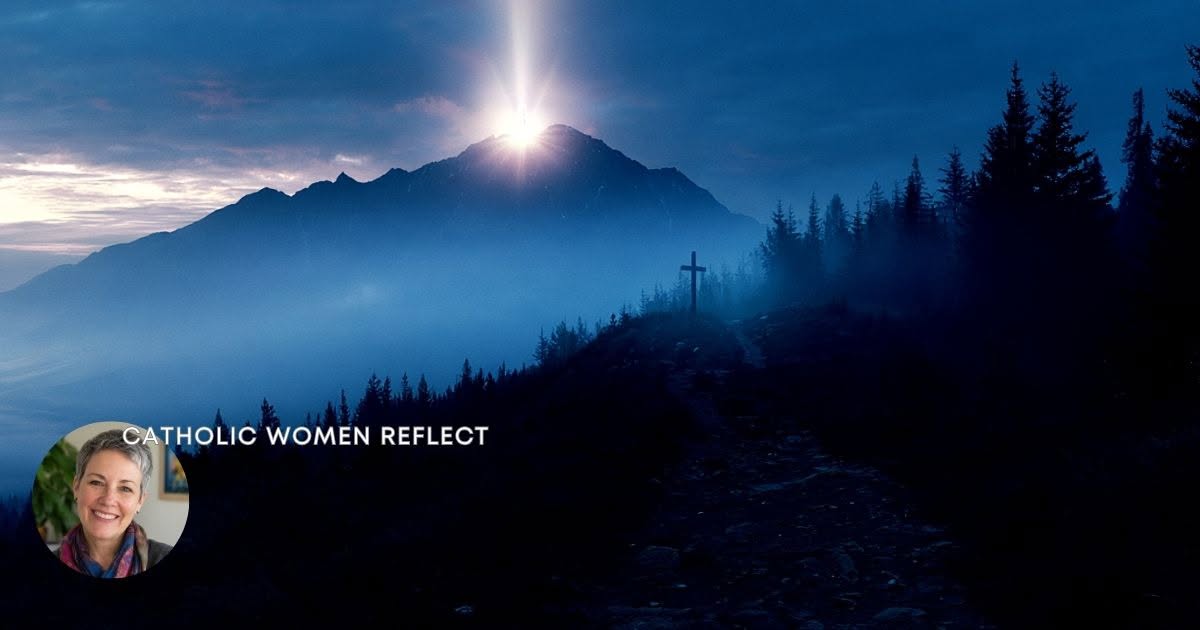
The Transfiguration is one of the most luminous moments in the Gospel. Jesus leads Peter, James, and John up a high mountain, and there his face shines like the sun. His clothes become white as light. Moses and Elijah appear. A cloud overshadows them, and the voice of God speaks: “This is my beloved Son, with whom I am well pleased; listen to him.”
It is a moment of beauty, clarity, and unmistakable holiness.
And yet it comes as Jesus is moving toward Jerusalem.
The disciples are given this glimpse of glory not so they can avoid what is coming, but so they may remember who Jesus is when everything later seems to contradict it. They will see him betrayed, humiliated, tortured, and crucified. The radiant face on the mountain will become a face bruised and bloodied. The beloved Son will appear abandoned.
The Transfiguration does not remove the cross. It prepares them to face it.
Many of us have known moments when God felt close and life seemed briefly clear. Perhaps it happened during prayer, at Mass, beside someone we loved, in the birth of a child, in the quiet of nature, or in an unexpected moment of peace. We may have wished, like Peter, to remain there and build a shelter around the experience.
But the brightness does not last.
We come down the mountain and return to ordinary life. Illness arrives. A relationship changes. A child struggles. A loved one dies. A prayer seems unanswered. We may wonder whether the grace we once felt was real.
The Gospel answers gently: yes, it was real. But it was never a promise that suffering would not come.
I have learned that moments of consolation do not protect us from grief. They do not make loss easier to explain. They do not turn sorrow into something simple or beautiful. But they can become a kind of light carried in the memory.
After my son was stillborn, there was no spiritual insight that could make his death acceptable. There was no bright moment that erased the darkness. Yet over time, small signs of love, prayer, presence, and mercy became enough to help me take the next step. Not answers. Not explanations. Light for the road.
This may be what the disciples receive on the mountain. Not an escape from suffering, but a revelation strong enough to remember when faith becomes difficult.
The voice from the cloud says, “Listen to him.” Listen to Jesus when he speaks of love, mercy, suffering, and resurrection. Listen when he tells the frightened disciples to rise. Listen when he says, “Do not be afraid.”
Hope does not mean pretending the cross is not heavy. Christian hope looks directly at suffering and still trusts that suffering does not reveal the whole truth about God, about us, or about the future.
There is more to Jesus than the cross, though the cross is real. There is more to our lives than the darkest thing we have endured, though its wound may remain. The light of the Transfiguration does not cancel sorrow. It tells us that sorrow will not have the final word.
We cannot stay on the mountain. But neither do we descend alone.
Jesus goes with us.
Prayer
Jesus, radiant on the mountain and faithful on the road to Calvary,
help us remember your light when the way grows dark.
Do not let us use hope to deny pain
or faith to silence grief.
Give us enough courage for the next step,
enough trust to keep listening,
and enough light to believe that the cross is not the end.
Walk with us down every mountain
and through every valley.
Amen.
Leave a Reply