
A reflection on Isaiah 5:1–7 for the 27th Sunday in Ordinary Time Year A.
I would like my children to know their prayers by heart. I try to help them understand why we go to Mass, why we honor Our Lady, and why the traditions we keep as a Mexican Catholic family matter. And I hope they carry these ideas into their own homes someday. But when I read Isaiah’s song of the vineyard, I wonder what else I am teaching them.
In the reading, the owner has done plenty for his vineyard. He has cleared the stones, planted healthy vines, and even prepared a place for the harvest. So he expects good grapes. Then Isaiah tells us what God was looking for among his people: justice and righteousness. But he hears the cries of those who have been treated unfairly or excluded.
Hmm… . I spend plenty of time and energy making sure my children learn the faith. But all too often, I don’t think about how I speak to them at the end of a long day.
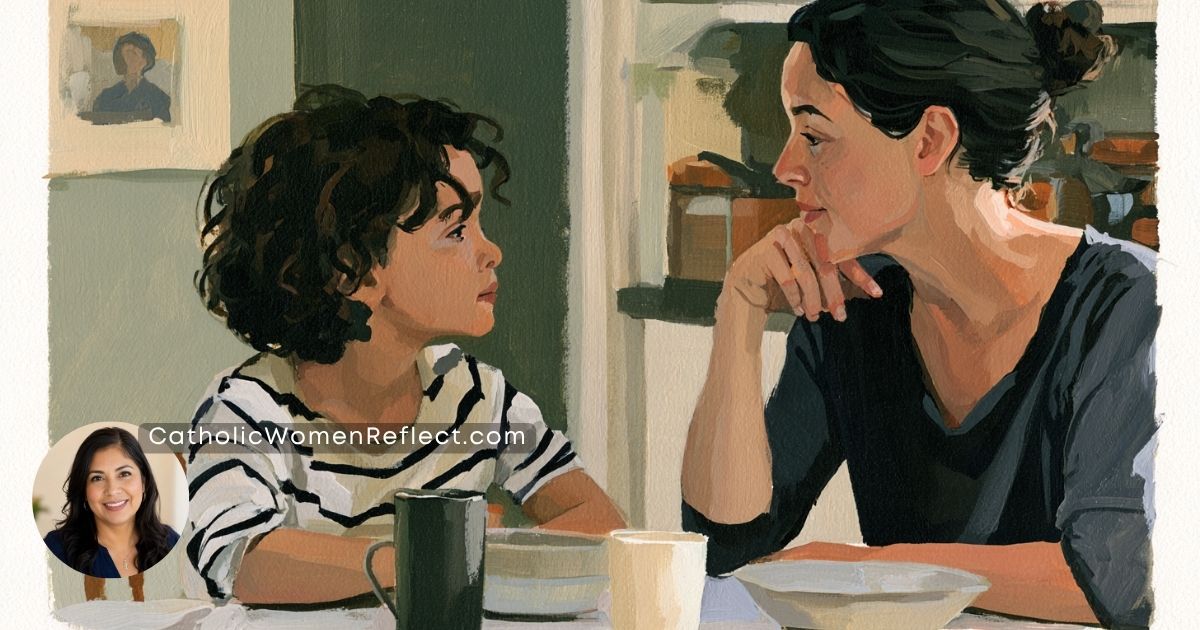
What does a child understand about mercy if I bring up an old mistake every time we disagree about something? What do they learn about fairness if I listen patiently to one child but assume the other is always the one stirring up trouble? I can explain away my impatience. I have dinner to prepare, supplies to find for a school project no one mentioned until now, and three children who all need a piece of my time. They hear my voice and they see my face.
I am their mother. I am responsible for correcting them, and sometimes that means saying something they do not want to hear. Kindness is not the same as giving them a free pass. . But sometimes I need to pause to ask whether I am correcting less than perfect behavior or simply letting my frustration fall on whoever happens to be nearest.
It seems easier to notice a disrespectful tone in my children than in myself.
I also think about what my children learn from the way I speak about people beyond our family. Their little ears are really good at hearing a conversation even when they seem busy with something else. Will they notice if I gossip about someone and then remind them to be charitable? If I say every person has dignity, my children should be able to hear that in my words.
Prayers and traditions can help me with this. When we pray together, I am asking for grace too. When I bring my children to Mass, like everyone there, I come as someone who needs forgiveness. I need to remember that. Faith is not just something I am responsible for placing in everyone else.
I know I will get it wrong sometimes. On those days, I just need to say, “I was right to ask you to do that, but I was wrong to speak to you that way. I am sorry.” My children need to know that being their mother does not excuse me from admitting I made a mistake.
I can’t make decisions for my children as they grow. Sometimes I wish I could. I can teach them, pray for them, and set limits. I can also be aware that I need to be an example for them, especially in the little moments when I am not thinking about teaching anything.
Isaiah leaves me with a question I need to pray about: Is the faith I work so hard to pass on making me more kind and fair toward the people in my care?
Right now, I can start by listening long enough for my child to finish explaining. I can correct with love and understanding. And when I owe someone an apology, I can give it before we say our bedtime prayers.
Lord, thank you for the children you have entrusted to my care. Help me listen with patience, correct with kindness, and treat each of them fairly. When I speak in anger, give me the humility to ask forgiveness. Let the faith we practice at home guide my words and actions, so my children can learn from me how to love you and care for others. Amen.