
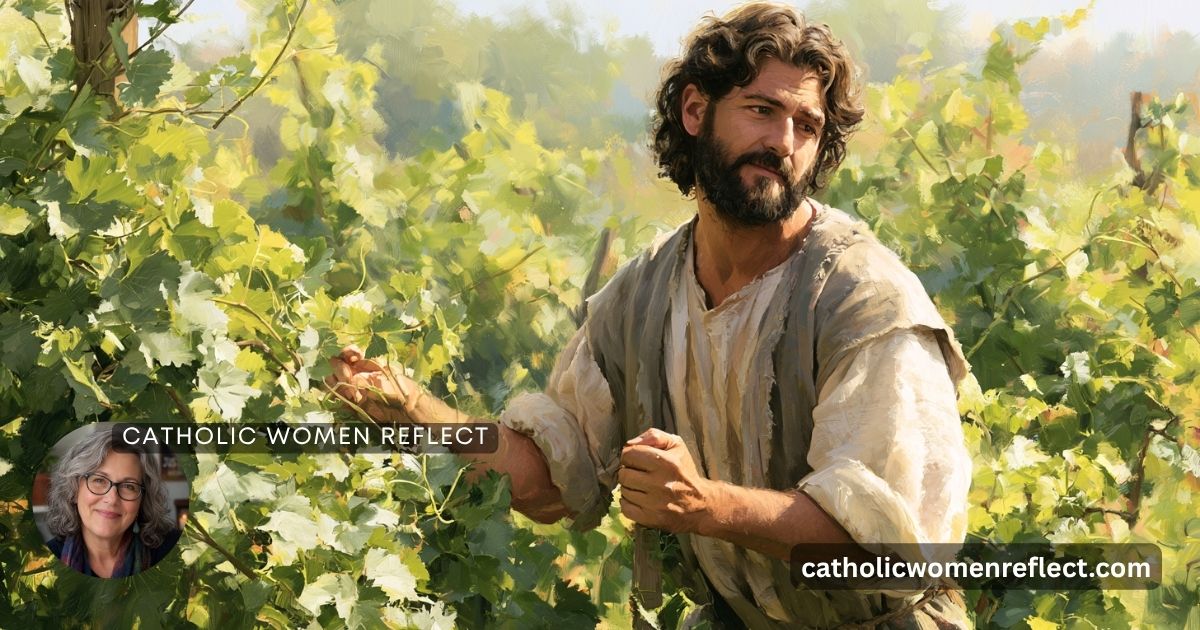
A reflection on Matthew 21:28–32 for the 26th Sunday in Ordinary Time Year A.
There is something deeply hopeful about the first son in today’s Gospel. His first answer is not noble, generous, or obedient. His father asks him to go work in the vineyard, and he simply says no.
Maybe he is tired. Maybe he is angry. Maybe he resents being asked, or perhaps he just does not want to go.
But then something happens.
Jesus tells us that the son changes his mind and goes.
That small turn is the heart of the parable. The son does not begin with the right words, but he eventually moves in the right direction.
We often think of repentance as something dramatic, but sometimes repentance is simply the willingness to reconsider. It is the moment when we realize that the answer we gave yesterday no longer holds up in the light of what we know today.
That kind of change can be difficult because most of us like to think of ourselves as consistent people. We want to believe that our convictions are well considered, our judgments are fair, and our first instincts are basically sound.
But discipleship sometimes asks us to become less attached to being right and more committed to becoming truthful.
The son who said no had to live with the discomfort of reversing himself. He had to admit, at least to himself, that his first answer was not the answer he wanted to keep giving.
There is humility in that.
We are allowed to change our minds about people. We are allowed to recognize that someone we judged too quickly carries a story we never bothered to learn. We are allowed to discover that a group we once spoke about dismissively is made up of actual people whose dignity deserves more than our assumptions.
We are allowed to change our minds about justice, mercy, poverty, immigration, race, sexuality, punishment, forgiveness, and belonging. We are allowed to let experience, prayer, Scripture, and the suffering of other people complicate what once seemed simple.
We are even allowed to change our minds about God.
Perhaps we once imagined God primarily as someone watching for failure, keeping score, and waiting for us to get things right. Then, over time, we begin to recognize the God who keeps calling, keeps inviting, keeps making room for us to return.
That is not weakness. It is conversion.
The Gospel does not praise the son because he gave the perfect answer the first time. It praises the fact that he eventually went into the vineyard.
That matters because many of us have places in our lives where our first answer to God has been no. We have resisted forgiveness, avoided hard truths, ignored someone’s pain, protected our comfort, or convinced ourselves that a difficult situation was simply not our responsibility.
The hopeful part is that no does not have to be the final word.
We can reconsider.
We can go back to the person we dismissed. We can apologize. We can listen more carefully. We can support something we once opposed. We can admit that our certainty was partly fear. We can let God lead us somewhere we never expected to go.
Sometimes the work of conversion begins not with a grand spiritual experience but with an uncomfortable sentence: I may have been wrong.
That sentence can open a door.
The second son in the parable gives the better answer at first. He says yes, but he never goes.
That is perhaps the more uncomfortable warning for those of us who know the language of faith. It is possible to say all the right things, belong to the right community, know the right prayers, and still resist the actual work of love.
Jesus seems less interested in whether our first answer sounds faithful than in whether our lives eventually move toward the vineyard.
The vineyard is where love becomes concrete. It is where mercy costs us something, where justice requires more than agreement, and where compassion becomes action.
We do not have to arrive there perfectly.
We only have to remain willing to change direction.
Journaling Prompts
- Where in my life have I recently changed my mind about a person, belief, or situation? What helped me see differently?
- Is there an area where I may be more attached to being right than to being truthful?
- Where have I said yes to God in words but resisted in practice?
- Is there someone I have judged too quickly or understood too narrowly?
- What might it look like for me to “go to the vineyard” this week?
Leave a Reply