
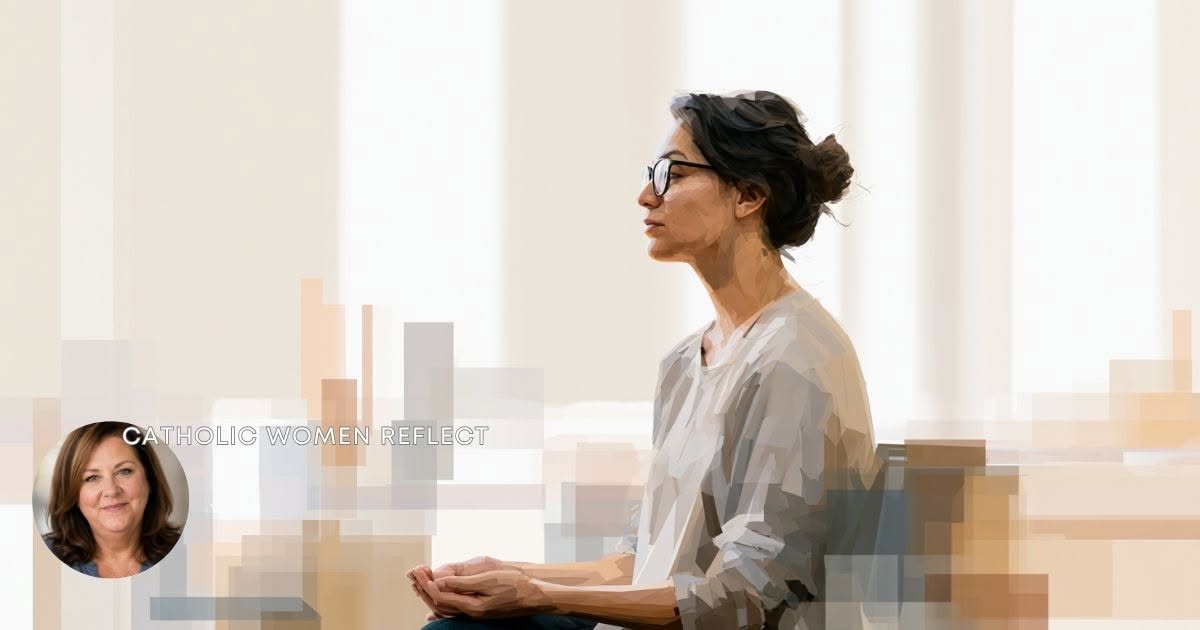
A reflection on Luke 6:6-11 for Monday of the 23rd Week in Ordinary Time.
There are some things we learn to hide. Not because they are shameful, exactly, but because they hurt. Sometimes we are tired of explaining them. Sometimes we have prayed about them so many times that even bringing them up again feels exhausting.
In today’s Gospel, Jesus meets a man with a withered hand. I have always wondered about that man. How long had he lived with it? How much had that hand limited him? How many times had someone stared at it? How many ordinary things had become difficult because one part of his body simply would not do what it was supposed to do?
And then Jesus tells him, “Stretch out your hand.”
That gets me.
Jesus asks him to bring forward the very thing that does not work. He does not say, “Show Me your good hand.” He does not ask the man to demonstrate how strong he is, how faithful he has been, or how well he has learned to compensate. He asks for the withered part.
I know something about wanting to keep the withered parts tucked in close. There are places in family life that can feel that way: relationships that did not turn out as we hoped, a marriage that ended, a child you love with your whole heart who has stepped away from the faith you wish he still practiced, an aging parent whose needs increase while your own energy seems to decrease, or old hurts you thought you had forgiven until one little comment brings the whole thing back to life.
And then there are the prayers. Goodness, the prayers. The ones we have prayed for years. The Rosaries where the same name comes up again and again. The candles lit. The novenas started with great confidence and finished with considerably less. The whispered prayers during Mass. The quiet bargains we know we probably should not be making with God: “Lord, please fix this. Lord, bring him back. Lord, make this easier. Lord, I cannot carry this much longer.”
Sometimes nothing seems to change.
That is where this Gospel becomes both comforting and challenging. Jesus does not ask the man to heal his own hand. He only asks him to stretch it out. There is a world of difference between those two things.
I think sometimes I come to God believing I have to hand Him a finished product. I want to say, “Lord, I have forgiven everybody, surrendered everything, stopped worrying, trusted You completely, and here is my beautifully organized spiritual life.” Wouldn’t that be nice?
But that is not usually what I have to offer. Most days, what I have is the withered hand: the thing I cannot fix, the relationship I cannot control, the person I cannot change, the fear I keep dragging around, the resentment I thought I had buried, the unanswered prayer. And Jesus says, “Stretch it out. Bring it here. Let Me see it. Stop hiding it from Me as though I do not already know.”
There is vulnerability in that. To stretch out the wounded place means admitting that it is wounded. It means admitting that love does not always produce the outcome we hoped for, that faithful parenting does not guarantee faithful adult children, that marriages can break, that caregiving can be exhausting even when it is done with love, that grief can coexist with gratitude, and that trust in God does not mean we never get tired, frustrated, lonely, or afraid.
Faith is not pretending the hand is fine.
Faith is stretching it toward Jesus anyway.
And notice what happens. The man stretches out his hand, and it is restored. That word—restored—is beautiful, because restoration does not always mean going backward. God does not always restore our lives by putting everything back exactly the way it was. Sometimes He restores us by making something new.
He may not restore a relationship in the form we once imagined, but He may restore peace in our hearts. He may not remove the burden of caregiving, but He may give us patience for one more day. He may not answer a prayer for a loved one on our timetable, but He may teach us how to love without controlling. He may not erase the history of a divorce, a betrayal, or a family wound, but He may slowly take away its power to define us.
Restoration belongs to God.
Our part is to stretch out the hand.
There is something else in this Gospel I cannot ignore. While Jesus is healing a man, other people are watching Him, trying to find something wrong with what He is doing. Can you imagine? A man is healed, and instead of rejoicing, they are furious. That is what happens when rules, pride, and the need to be right become more important than mercy.
Jesus reminds us that people matter. The wounded person matters. The suffering person matters. The person with the complicated story matters. The divorced woman matters. The aging parent matters. The adult child who no longer comes to Mass still matters. And yes, the person whose choices we deeply disagree with still matters.
Jesus sees the withered hand before He sees an argument.
That alone gives me plenty to pray about.
Maybe today there is something we have been keeping tucked close: a disappointment, a fear, a family situation, a prayer that feels unanswered, or a part of ourselves we wish were stronger, holier, calmer, or less wounded. We do not have to fix it before bringing it to Jesus. We do not even have to understand it.
We only have to hear His invitation: “Stretch out your hand.”
So bring Him the part that hurts. Bring Him the child you cannot bring back to church yourself. Bring Him the relationship you cannot untangle. Bring Him the grief you still carry, your aging loved ones, your loneliness, and the prayer you are almost tired of praying. And if all you can manage today is to whisper, “Jesus, I give this to You again,” then do that.
Stretch out the hand.
Let Him decide what restoration will look like. Because the wounded places we hide are often the very places where Christ is waiting to meet us.