
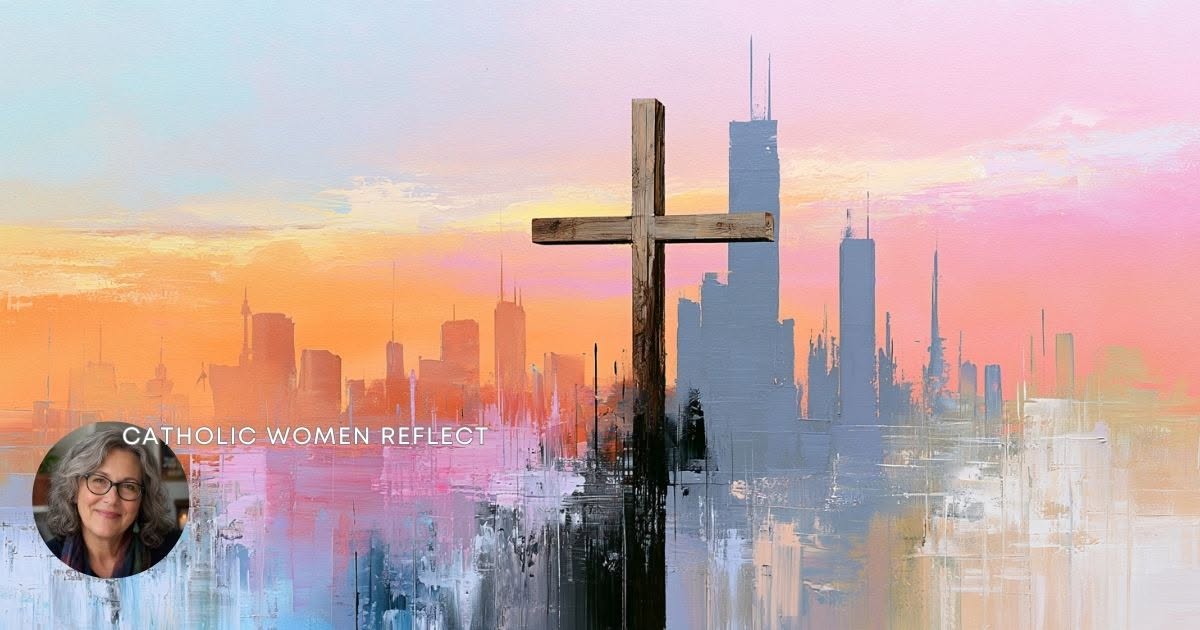
A reflection on 1 Corinthians 1:17-25 for Friday of the 21st Week in Ordinary Time.
I have seen crosses so often that it is easy to forget what they meant at first.
They hang in churches, classrooms, homes, and around people’s necks. We decorate them beautifully. We polish them. We place them where they can be seen.
And somewhere along the way, the cross can become familiar enough that I stop feeling the shock of it. It was a method of execution for criminals. For us today, it would be like an electric chair or a lethal injection symbol.
Paul does not let me forget that.
He reminds us that a crucified Messiah sounded foolish. Weak. Defeated. Embarrassing. The world expected power to look like victory, control, strength, and status. God chose a condemned man hanging on a cross.
That should unsettle me.
Because if I am truthful, I still prefer the kind of faith that feels successful.
I like prayers that bring peace quickly. I like service that is appreciated. I like being generous when it does not cost too much. I like forgiveness better in theory than when I am the one who has been hurt. I like humility until I have to admit that I was wrong.
Apparently I am quite willing to follow Jesus, provided the road stays reasonably convenient.
Then I look at the cross.
The cross tells me that love may ask something from me.
It may ask me to stay beside someone who is suffering when I would rather escape the discomfort. It may ask me to forgive without receiving the apology I hoped for. It may ask me to speak up when silence would be easier. It may ask me to give up being right, admired, comfortable, or in control.
None of that fits very well with the way our culture usually defines success.
We are taught to protect ourselves, build influence, win arguments, and avoid looking weak. Even within the Church, we can become impressed by numbers, prestige, wealth, visibility, or political access.
The cross points in another direction.
Jesus does not conquer by crushing his enemies. He gives himself away.
That kind of power still looks foolish.
I find that especially challenging when I think about people who are suffering. It is easy to admire the cross as a symbol while keeping a safe distance from people carrying crosses of their own.
The poor. The lonely. The migrant. The prisoner on death row. The person who has been rejected by family or Church. The person whose grief has lasted longer than everyone else thinks it should.
Solidarity sounds beautiful until it requires us to rearrange our lives.
The cross asks whether we are willing to stay close.
It also exposes how deeply I want control. I would much rather know how things will turn out. I want the clear plan, the reasonable explanation, the guarantee that faithfulness will produce the result I hope for.
The cross offers none of that. It shows us Jesus trusting the Father while everything looks lost. That is a difficult kind of faith.
Paul calls it the wisdom of God.
Maybe the cross still offends us because it keeps challenging the things we instinctively admire. It refuses to let strength mean domination. It refuses to let success mean winning. It refuses to let love remain sentimental.
The cross makes love concrete.
Love forgives.
Love serves.
Love stands beside people who are suffering.
Love gives without always knowing what will come back.
Love sometimes loses by the world’s standards.
And yet Paul says this apparent foolishness is wiser than human wisdom.
I do not think the goal is to go looking for suffering. Jesus never asks us to romanticize pain or accept abuse. The cross is not permission for anyone to harm another person.
But following Christ does mean that comfort cannot be our highest goal.
Sometimes love will inconvenience us. Sometimes mercy will cost us pride. Sometimes justice will require courage. Sometimes faithfulness will look foolish to people who measure everything by power and success.
That is where the cross becomes more than something I wear or look at.
It becomes a question.
Am I willing to follow a Savior whose way of winning looks like self-giving love?
Or have I quietly reshaped Christianity into something more comfortable?
I suspect I will spend a lifetime answering that.
Journaling prompts
- Where have I made my faith more comfortable than the Gospel asks it to be?
- What part of the cross do I find hardest to accept: forgiveness, humility, sacrifice, solidarity, or letting go of control?
- Who is carrying a cross near me that I have kept at a safe distance?
- What would self-giving love look like in one concrete choice this week?
Leave a Reply